
Variational – The Forbidden Paradigm Shift: Hacking Perps into Programmable, Zero-Fee Mayhem.

Executive Summary
This entire research piece captures the evolution of the Derivatives landscape from 2020–2026, anchoring key leaders, the comparative table of trading models (CLOB, AMM, vAMM, Hybrid, Oracle and RFQ), the nuanced dissection of legacy flaws across orderbooks, funding rates, and liquidity illusion, and which deep dives into Variational’s P2P architecture as one structural truth stands out.
Legacy perps (CEX giants like Binance/Bybit and DEX hybrids from Perpetual Protocol through Hyperliquid, dYdX, GMX, Drift, Aster, and beyond) remain trapped in shared orderbooks and pools that create HFT/MEV execution taxes, periodic funding bleed, fake depth, full-wick liquidations, and cascading downturns flaws repeatedly proven in 2022–2025 flash events.
Variational Protocol’s isolated P2P/RFQ and Omni Liquidity Provider model on Arbitrum dismantles every one of these legacy weaknesses. With per-trade bilateral escrows, on-demand quoting, sophisticated non-1:1 external hedging, counterparty-aware risk limits, adaptive CEX-aligned funding and partial liquidations, all delivered at zero trading fees, it delivers deeper, more efficient, and trader-aligned liquidity than any resting-orderbook system ever could.
This research arc positions Variational not as another competitor, but as the cleanest evolutionary reset in DeFi perps the protocol that finally scraps the old playbook and wins the liquidity wars.
1. Introduction - Igniting the Rebellion
The present state of the perps landscape: A brief intro highlighting the current perps landscape.
“Here’s to the crazy ones. The misfits. The rebels. The troublemakers. The round pegs in the square holes. The ones who see things differently. They’re not fond of rules. And they have no respect for the status quo. You can quote them, disagree with them, glorify or vilify them. About the only thing you can’t do is ignore them. Because they change things. They push the human race forward. And while some may see them as the crazy ones, we see genius. Because the people who are crazy enough to think they can change the world are the ones who do.”
― Steve Jobs
Can you make some sense of this quote from the standpoint of where we are today?
Over the years, since the last DeFi Summer, we’ve seen a revolutionary shift in the Derivatives (Perps) Sector. The key leaders from then aren’t the key leaders today at the time of writing. The runner-ups gave up in the middle of the race, the underdogs were hunted and in dismay, they slowly walked away.
This would be an intriguing read, yet a call to order that would make you question the status quo and put you in an existential state, with the choice between Utopia and Dystopia.
BitMEX popularised Perps in 2016 and Perps emerged as a key innovation during the DeFi Summer. The Perps landscape has come a long way and our fallen heroes who laid the foundation for the nobles today are not meant to be forgotten.
Here’s a concise Timeline of major DeFi Perps from 2020/2021 to date, and how they have evolved in terms of model, design, and key innovative features.
The adoption in the Perps sector can be viewed in three different ways:
Early Era (2020 - 2021)
Growth Era (2022 - 2023)
Maturity Era (2024 - 2026)
The early era focus was on basic perps amid the DeFi Boom, in which the growth era relied on new chain expansions, higher leverage and competition and the maturity era, while not mostly specializing on a key thing, but encompasses what the previous era begets and most importantly, bridging the gap between Onchain and TradFi, targeting stocks, equities, FX, metals etc
The maturity era is also competing for who has built a moat, targeting liquidity and institutional adoption.

In the early phase (2020 - 2021)
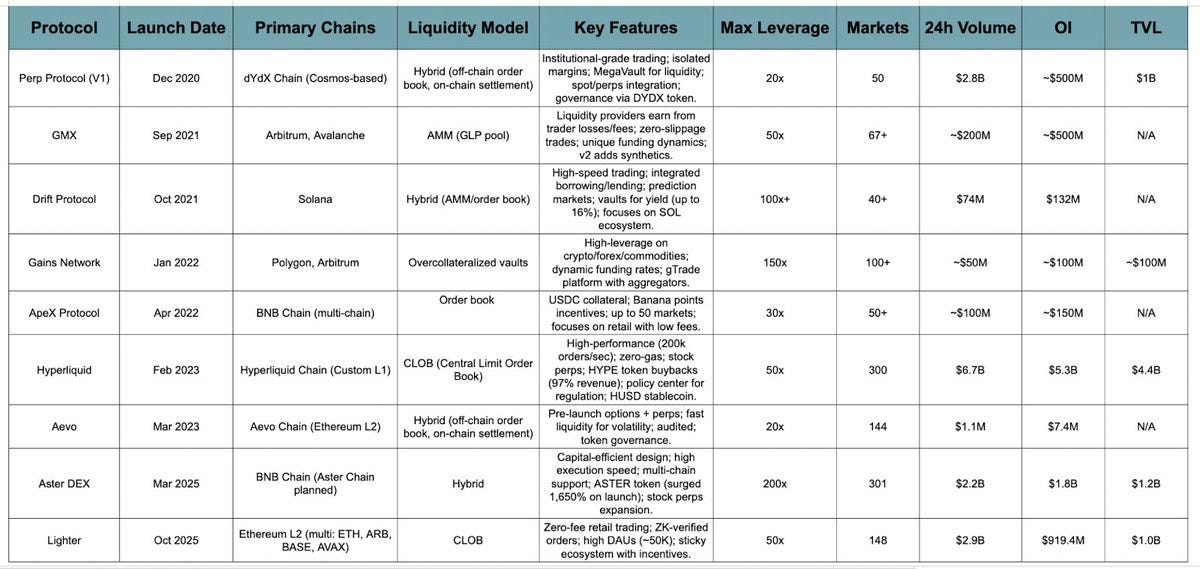
Perpetual Protocol (v1) launched in December 2020, which focuses on vAMM (Virtual) model for liquidity without traditional orderbooks and offered up to 10x leverage on asset pairs. They pioneered onchain perps and reached a TVL of $100M. In the later stage, they launched their v2 on Optimism in August 2021, with improved funding rates and USDC collateral.
2021 Saga Continua
In April 2021, we had the Calculus of the Perps sector dYdX v3, with the earliest version dating back to 2019. Then, I was in my final year at the University and I loved every bit of Differentiation and Integration and this genuinely piqued my interest to ever try out a Perps amidst the risk of leverage and liquidation; nevertheless, there’s always a first time.
dYdx launched as an Ethereum L2 built on StarkEx tech, featuring a hybrid order book model with offchain matching and settlement with up to 20x leverage on a few asset pairs. dYdX dominance was a loud one indeed and coupled with one of the most generous 5-6 figure airdrops back then.
dYdX dominance was one that would make you question your career choice to ask yourself: “Why didn’t I build a Perp DEX”?
It dominated the Perps sector with >80% market share and reached a cumulative volume of $1.47T by 2024.
On top of that, they migrated to v4 on a custom Cosmos-based chain in October 2023 for improved performance, and added isolated margins and instant listings in 2025.
In September 2021, we all hail thee, Arbitrum’s favourite and sweetest burberries mankind has ever witnessed, “GMX”. In fact, GMX was the top protocol and the flagship project in the Arbitrum ecosystem at that time. You will nearly have a migraine comparing GMX and dYdX head-to-head on hype and performance. GMX’s UX was everything traders wanted and it gave birth to vaults (GLP). Perp Vaults that earn users “Real Yield” This term was the most attractive word you’ll ever mention in the DeFi summer bull run and GMX was a key leader in the real yield narrative. GMX boasts of up to 50x leverage on majors like BTC/ETH and with core features like little to no slippage and no funding rates initially.
They gained significant traction during the 2022 bull run and launched v2 in 2023, adding synthetic assets. GMX reached a daily peak volume of $700M in March 2024, driven by incentives.
In October 2021, Solana has to bring home the Bacon and here comes “Drift Protocol” and of course why won’t you love it or also want to have a piece since airdrops are the one of the best asymmetric bet then, we saw an inflow of liquidity to the Solana ecosystem which made Drift Protocol one of the best Perps ever built on Solana with its hybrid AMM/order book for perps, borrowing/lending integrated. Up to 10x leverage (later 50x–101x by 2026) on 40+ assets, prediction markets and vaults Inclusive.
Drift Protocol volume surged post-FTX, reaching a 24h volume of $74M, Open Interest (OI) of $132M, and yields of up to 16%.
The Perps Renaissance (2022 - 2023)
“Learning never exhausts the mind”, Leonardo da Vinci
Amidst the previous development, there were so many improvements to be made. In January 2022, we saw a major shift in the Perps landscape brought by Gains Network, which launched on Polygon and later migrated to Arbitrum. Gains Network introduced gTrade, with overcollateralized vaults for liquidity, up to 150x leverage on crypto, forex, and commodities, and dynamic funding rates, with TVL peaking at $100M.
In April 2022, BNB Chain joined the war brought upon by “ApeX Protocol”, which features an orderbook model with USDC collateral and up to 30x leverage across 50+ pairs. It also ranked among the top 10 Perps DEX at that time.
In February 2023, the birth of a new era emerged, welcoming the grandmaster “Hyperliquid”, the harbinger of CEXs’ doom, the nightmare in broad daylight, the slayer of Theokoles, the rebel king and that wasn’t just it, It boasts a high-performance order book, zero-gas trading, and up to 40x leverage on 100+ perps (crypto, stocks) by 2025.
Hyperliquid did the most unbelievable Perps airdrop of all time, turning children of men into millionaires overnight. Hyperliquid disrupted the Perps space, rising from a 0.3% share in 2023 to 70%+ by 2024. 2025 volume: $3T annualised, $21B daily peak (January 2025). By 2026, it already dominates with $5.5B OI, $6.4B 24h volume; added policy centre for regulation and stablecoin (HUSD) in 2025.
In March 2023, Aevo launched as an Ethereum L2 chain formerly known as Ribbon Finance, which also ran one of the most notable six-figure airdrops in the Perps landscape. It featured a hybrid order book/on-chain settlement. Up to 20x leverage on 144 assets. Pre-launch options trading. Still active in 2026 with some notable stats of 24h volume ~$1.1M and an OI of $7.4M.
In 2024, there weren’t any major launches but upgrades on dYdX v4 full rollout (from 2023 beta), emphasising MegaVault ($12M TVL by 2026). GMX also rolled out v2 enhancements with Chainlink oracles and Hyperliquid’s post-TGE monthly volumes jumped to $160B–$315B.
The Maturity Phase (Late 2024 and Beyond)
The Industry is maturing, nature is healing, and the fight has always been against shady CEX and putting an end to all their value extraction, scam wicks, forced liquidations, and short squeezes. In fact, whatever manipulative acts you can think of.
In March 2025, we witnessed Aster DEX rebrand from APX Finance. It features a Hybrid model, up to 100x leverage on crypto/stocks. Its Token (ASTER) launched in September 2025, surging 1,650% (16.5x) on day 1.
Aster was horrendously shilled by CZ and which it competed h2h with Hyperliquid. Its daily volume peaked at $70B in February 2025 and, in September 2025, overtook Hyperliquid, reaching $282B monthly. By 2026, drives $2T quarterly records; TVL peaked at $17B.
In October 2025, Lighter went live on Mainnet, offering zero-fee trading in Perps with low latency and ZK-verified orders, up to 50x leverage. Its Beta phase hit $164B in volume in September, and as of today, it ranks 2nd in terms of Volume according to Defillama.
And here we are in 2026, which is basically the year of Institutional and chain upgrades and hence let the battle for liquidity begin.
This is the state of the current Perps landscape ranked by 30-day volume.
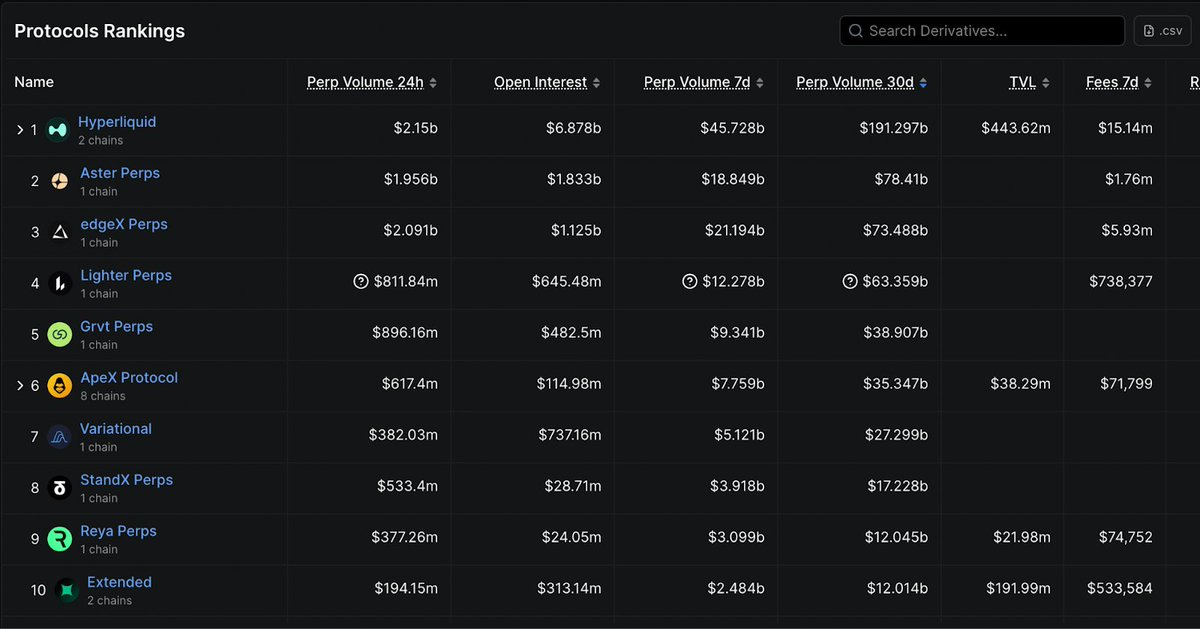
Hyperliquid still remains undefeated, despite the Lighter post-mortem airdrop saga; it’s still behind Hyperliquid. Aster has lost its crown; ApeX protocol remains the undefeated gladiator in the colosseum amongst its contemporaries.
And “Variational”, the long-awaited north star, the trailblazer redefining the Perps sector, has begun its era.
Below is a comparative table summarising these previous eras from DeFi Summer, including the key launches, design models, and metrics mentioned.
The Dying Empire of Orderbook Perps: Why Centralised and DEX models are Failing
To build an empire, you have to dominate a territory for a long period of time under battle-tested, tried and true conditions and most importantly, expansion.
The orderbook wars all started with Centralized Exchanges as the source of common truth for trading, but at some point, the flaws imposed by the risk of a centralized entity kicked in: Single point of Failure (SPOF), front-running behind the scenes because no one sees it onchain, lack of transparency and manipulations, custody and insolvency risks and regulatory/compliance vulnerabilities. Of course, this should raise every trader’s concern who has a passion for the game and human wants remain insatiable per se. Humans came up with the thought, “Why can’t we decentralise this system?” and create something that addresses these concerns. Then came the birth of AMM model, which was built by Uniswap.
The duel is set for the trader armies to pick sides, Centralized Exchange Orderbooks (executing offchain) vs Decentalized AMM Model (executing onchain). Despite the AMM model addressing these risks, it still has some flaws that couldn’t sustain its dominance today as the leading model for Perps trading, including impermanent loss (IL), slippage and price impact, sandwich attacks and front-running, scalability, and capital efficiency.
Then, humans learned the DEX AMM model flaws and wanted a much better design to address all these challenges, “Onchain Orderbook”
An orderbook is an orderbook, but the difference now is that it’s onchain; when compared with a centralised exchange orderbook, it eliminates the centralised intermediary.
The major advantage onchain orderbook has over the CEX orderbook lies in onchain transparency, self-custody and censorship resistance, while that of the AMM model lies in sophisticated trading functionalities like limit order, Time-weighted average price (Twap) that most AMM designs lack, direct order matching that the orderbook has, which leads to efficient execution for large trades and minimises slippage and most importantly, draws liquidity from market makers that direct and match buy/sell orders and earn through the bid-ask spread instead of from pool fees in AMM Liquidity Pools.
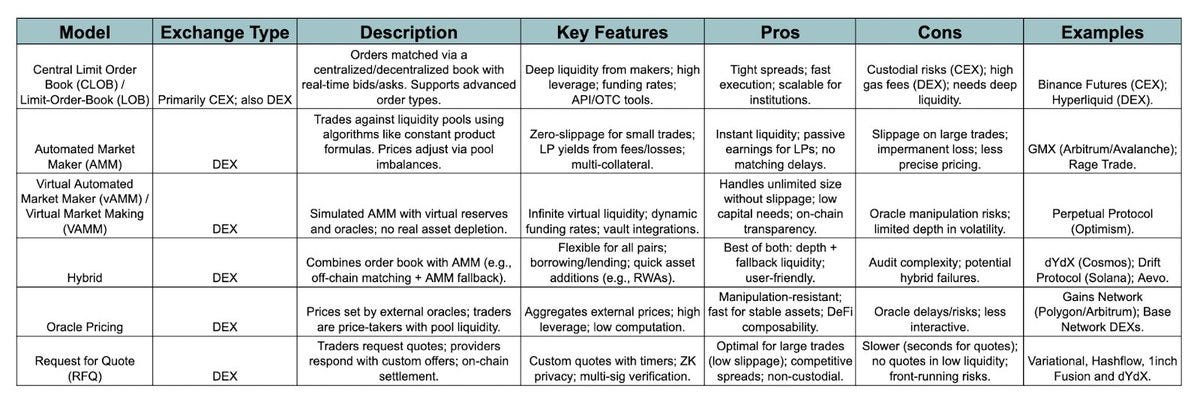
Then we witnessed the rise of Hybrid models (offchain matching and onchain settlement), which was the model used by GMX, Gains Network and Orderly Network. We also witnessed the era of Central Limit Order Books (CLOB) frenzy, which was majorly dominated by Hyperliquid, Aevo, Vertex Protocol, dYdX, Hibachi etc.
Much better progress has been made, but innovation is inevitable as long as human lives.
In the rest of this piece, we’ll uncover the RFQ model (Request For Quote), which is used by Variational and some newer Perps challenging the status quo. The RFQ model allows traders to request customized quotes from market makers or LPs for better pricing, especially on large or complex trades.
2. Background - The Hidden Cancer
The Nuance Flaws in Legacy Perps: Highlight Orderbooks, Funding Rates, Liquidity Illusion.
Trading is a Zero-sum game, since a trader has to gain for another to lose and vice versa, making it fair. Before highlighting the flaws in Legacy Perps, one should ask a question: why are Perps considered a Zero-sum game?
It is considered a zero-sum game due to:
Direct Counterparty Risk: Every time a long position is opened (Implying the price goes up), the long position is matched with an equivalent short position (Implying the price goes down). If the price rises, you gain money directly from the short holder and if it’s inverse, they gain from you.
Funding Rate Mechanism: Since Perps contracts do not expire like options, funding rates are used to keep Perps prices aligned with the spot price. When the market is bearish, the short pays longs and if it’s bullish, the long pays shorts.
Leverage and Liquidation: Since Perps allows high leverage, a small price move against the trader’s position without proper risk management can result in liquidation. When the position is liquidated and closed, the loss is transferred to the counterparty or the insurance fund, thereby validating the Zero-sum nature.
Fees: For every opening and closing of a position or other activities in a trading platform, fees are charged and the total money lost by losers is always slightly more than the total money gained by winners; the exchange takes the difference.
This is “ceteris paribus”, all things being equal and any deviation from this modus operandi could be a result of systemic risk, manipulations or malicious intent, resulting in inefficiencies.
Reflecting on 2025 in a bit
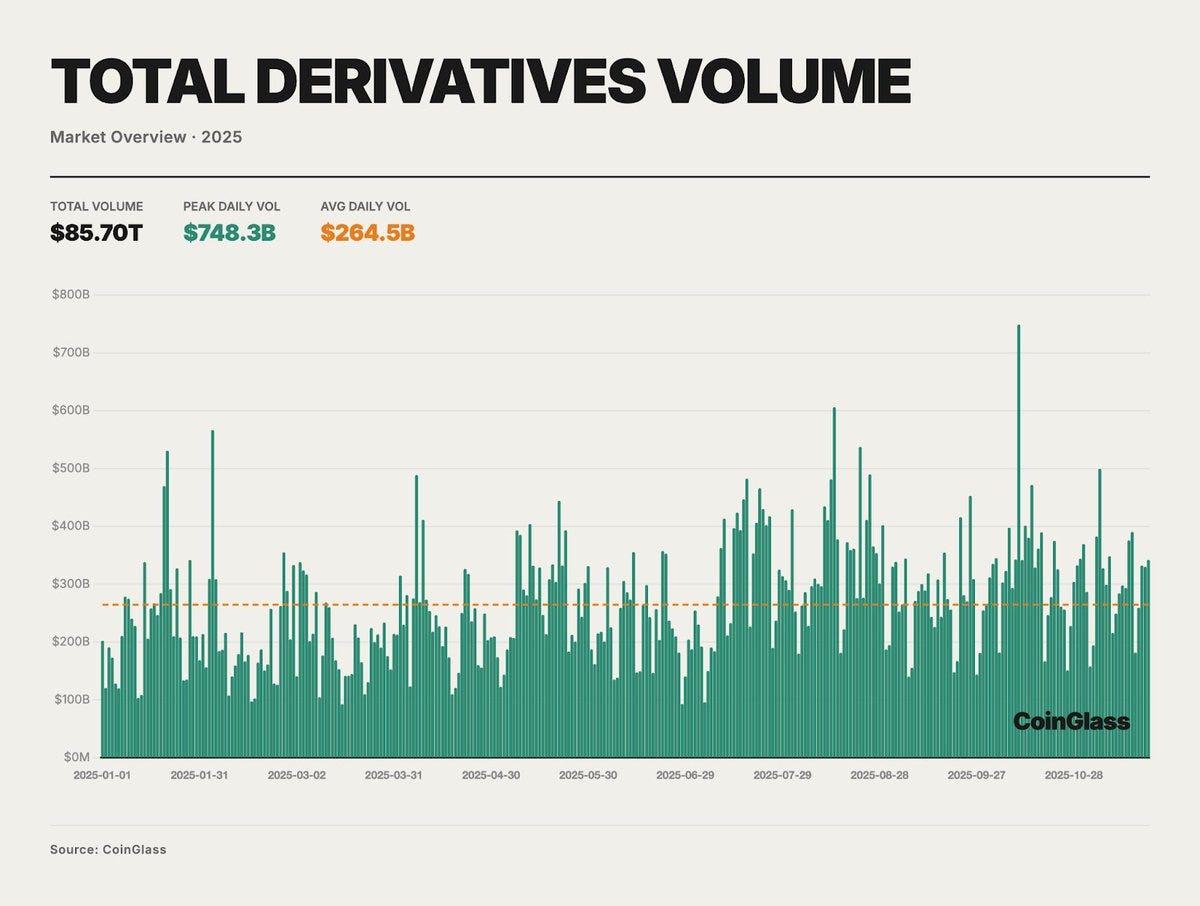
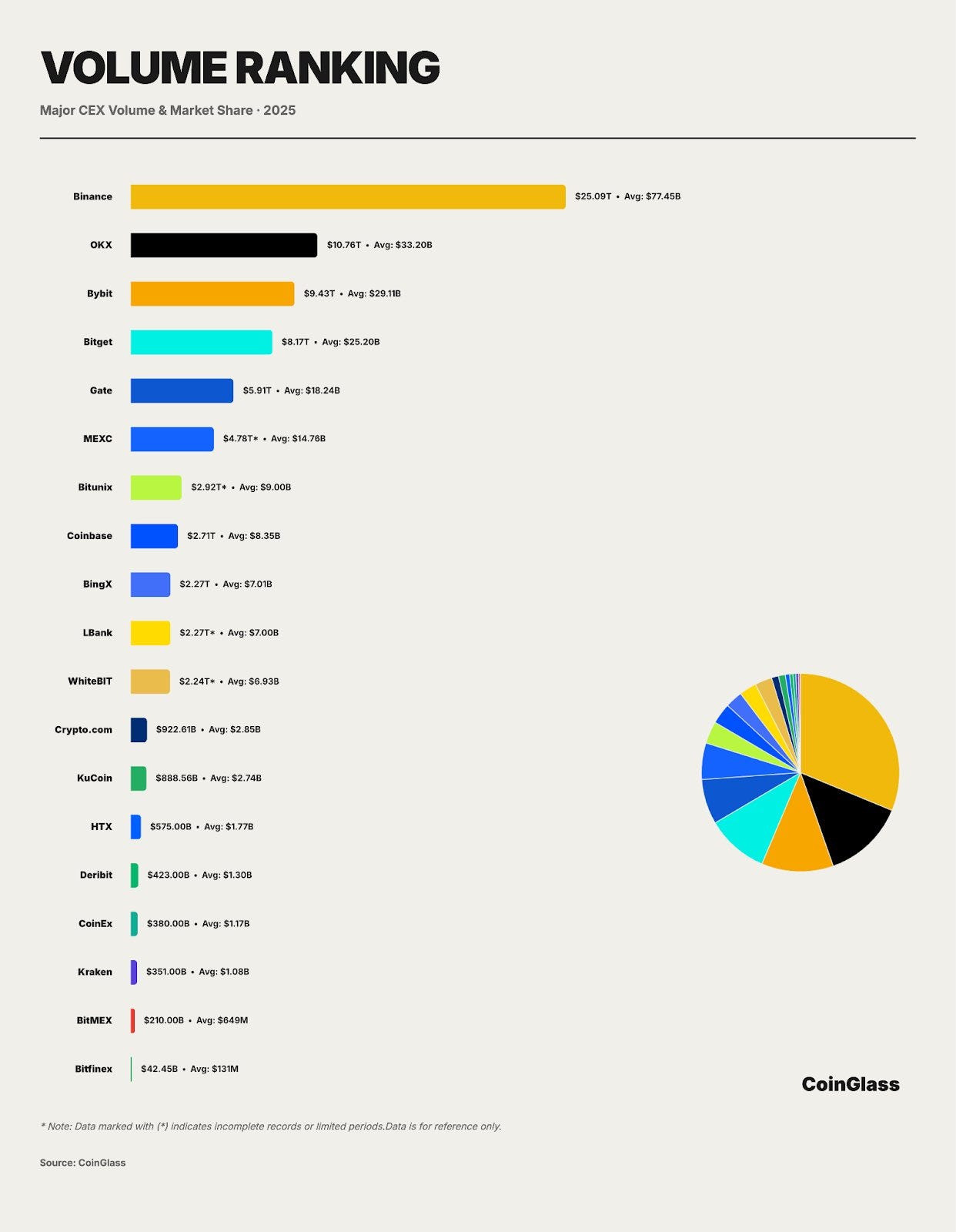
According to CoinGlass's research report, the total volume of cryptocurrency derivatives trading in 2025 was approximately $85.70 trillion, with an average daily trading volume of $264.5 billion.
In the CeFi Sector, Binance dominated CEX volume with a market share of 29.3%, averaging $77.45 billion daily and a total of $25.09T.
In the DeFi Sector, Hyperliquid stood out as the undisputed leader in the first half of 2025, with its market share at highs of 70-80% and open interest peaking at $15.66B.
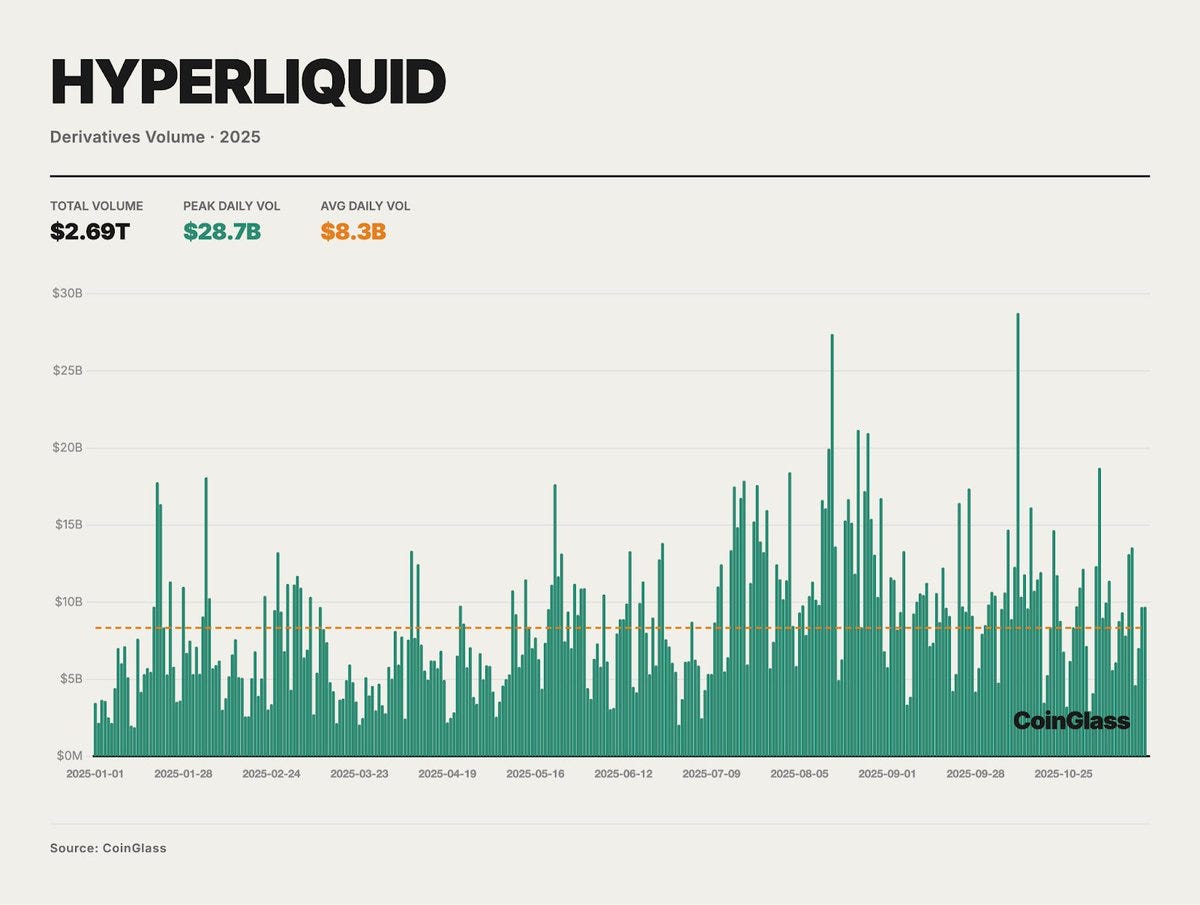
The entrance of top Hyperliquid competitors like Aster, Lighter, and EdgeX made strong waves, and Hyperliquid’s market dominance dropped to 30-40% by year’s end.
As highlighted, the majority of Legacy Perps use the CLOB model, in which bids and asks are matched against each other in a book. Both CEX and DEX dominance face some subtle challenges, with CEX more exposed to counterparty risk (as the FTX case study shows), regulations, and opaque execution, where users can’t verify whether they’re getting fair fills since the transactions are not onchain.
Moreover, the Orderbook model favours HFT (High Frequency Trading) as it offers large institutions an advantage over retail traders, especially in volatile markets.
On CEX like Binance and OKX, orderbooks allow “Free last look” or “Cancel Priority”, which allows market makers to place large orders to attract volume and can cancel them milliseconds before unpropitious moves. In turn, this leads to “Execution Tax” on retail traders via slippage.
This mostly happens during flash crashes and often leads to cascading events where liquidity evaporates as HFTs withdraw, causing orders to execute at worse prices. Binance, having processed over $25T in Derivatives, faced claims of opaque execution with potential accusations of front-running and manipulating Orderbooks since users can’t verify fair fills.

The Nuance in DEXes can be linked to high gas fees and latency. This amplifies MEV risk as validators can reorder transactions for profits. There are also cases of front-running, where bots snipe orders, increasing slippage for users. Unlike CEX, DEX orderbooks require subsidies for market makers to provide depth, creating hidden costs and shallow books during volatility. For example, in AMM-hybrid DEX, orderbooks fall back to pools, but mismatches can lead to “black-box” executions that are vulnerable to oracle delays.
Moreover, for Funding Rates, which are periodic payments that occur (every 1-8 hours) between longs and shorts to anchor perp prices to spot.
unding Rate is calculated as:
FR = (Perp Price - Spot Price) / Spot Price x K (where K is a coefficient). While essential for no-expiry contracts, legacy implementations can circumvent and create hidden costs.
The Nuance in CEX can be ascribed to CEX skewing rates to favour their books, especially in illiquid pairs, causing “funding bleed” where traders pay excessive rates (e.g.,12%+ annually in bull markets). During imbalances, like prolonged longs, rates spike, forcing premature exits and cascades. Also, FTX collapse highlights how centralized entities can tamper with rates without transparency. With DEX not being an exception, but on a different level, as they rely on external oracles for spot prices, there can be risks associated with (seconds-to-minutes) delays in oracle price fetching and manipulation risks via flash loans or oracle attacks. This distortion can incur excessive payments. Funding arbitrage is also exploited in this case and this tends to affect AMM-based models more as rates are tied to pool imbalances and shallow liquidity amplifies skews, causing LPs to suffer losses during shocks.
Furthermore, one of the major flaws in legacy perps is tied to Liquidity Illusion, fueled by Inflated metrics and fragile depth. This illusion conceals the mismatch between reported metrics (e.g TVL, Volume) and actual value, which are often inflated by design mechanics or incentives. CEX boasts of liquidity depth and the subtle shade can be discovered in a period of extreme volatility, especially during a market downturn, as subsidized market makers tend to pull liquidity.
The illusion in volume metrics includes wash trading, inflating figures without real depth. For major pairs, slippage is minimal, but for alts, it’s high, with exchanges sometimes faking depth via internal bots.
The nuance in DEX still follows the same pattern of vanity-inflated metrics or incentives just like the point system in Aster, which led to wash trading with Volume to TVL ratios >70:1 signalling fake activity.

AMM models promise “infinite” liquidity but suffer impermanent loss (IL) and slippage on large trades. vAMM on Perpetual Protocol uses virtual reserves, but reliance on oracles creates fragile depth during depeg.
These flaws underscore why the sector shifted toward app-specific chains and transparent mechanisms post-2024, reducing custody risks and improving efficiency.
Variational: Challenging the Status Quo.
Variational stands out as one of the most promising challengers to the legacy status quo. Launched with its Omni app on Arbitrum (mainnet beta ~Jan 2025, full rollout through 2026), it’s not just another perp DEX. It’s an onchain infrastructure layer for P2P derivatives that powers two apps: Omni (retail-focused perps) and Pro (institutional OTC/custom).
Variational leverages its RFQ + OLP (Omni Liquidity Provider) model to scrap the legacy playbook entirely. It doesn’t compete on raw TPS like Hyperliquid’s CLOB or GMX’s AMM pools. It re-engineers the economics and execution to fix these flaws.
Variational leverages these core features to challenge the legacy models:
RFQ (Request-for-Quote) Model (no orderbook at all).
Omni Liquidity Provider (OLP)
P2P Escrow + Automated Clearing/Settlement.
Pricing & Funding Mechanics.
Variational fights orderbook flaws by eliminating cancel-priority, free last-look, front-running, and liquidity evaporation. With RFQ, liquidity is on an as-needed basis (no resting orders to cancel or snipe). Its OLP’s proprietary engine generates dual-sided quotes from aggregated real-time data, no HFT gaming or MEV reordering. Last-look protects OLP without retail downside. Most importantly, Variational addresses funding rate manipulation, RFQ impact pricing + adaptive CEX-aligned windows since prices are quoted dynamically per trade and with Isolated escrows, which basically means imbalances stay contained (no systemic cascade like GMX pools or CEX ADL).
Variational prevents liquidity illusion through its OLP, providing real, aggregated depth (CEX/DEX/OTC feeds) without external LPs or TVL farming. No GLP-style impermanent loss and no virtual reserves like vAMM. It supports 500+ markets with tight spreads because liquidity isn’t “resting” or subsidized, it’s scanned and quoted on demand. It is also important to know the RFQ potential gaps, which introduce minor quote latency (seconds vs sub-ms on CLOB); OLP as sole counterparty creates single-point risk (hedged, but still); funding mechanics are adaptive but not as prominently dissected as RFQ.
3. In-depth Analysis: Dissecting Variational’s Arsenal
Technical mechanisms - RFQ Revolution: From Blind Matching to Bilateral Supremacy.
Most perp protocols today have converged on two dominant execution models: the Central Limit Order Book and the AMM. Both carry structural trade-offs: public order exposure, shared counterparty risk, fragmented liquidity across markets, and fees extracted by external market makers who keep the value for themselves.
Variational chose neither. It chose the RFQ model, Request For Quote, and the architecture it built around it is worth dissecting properly.
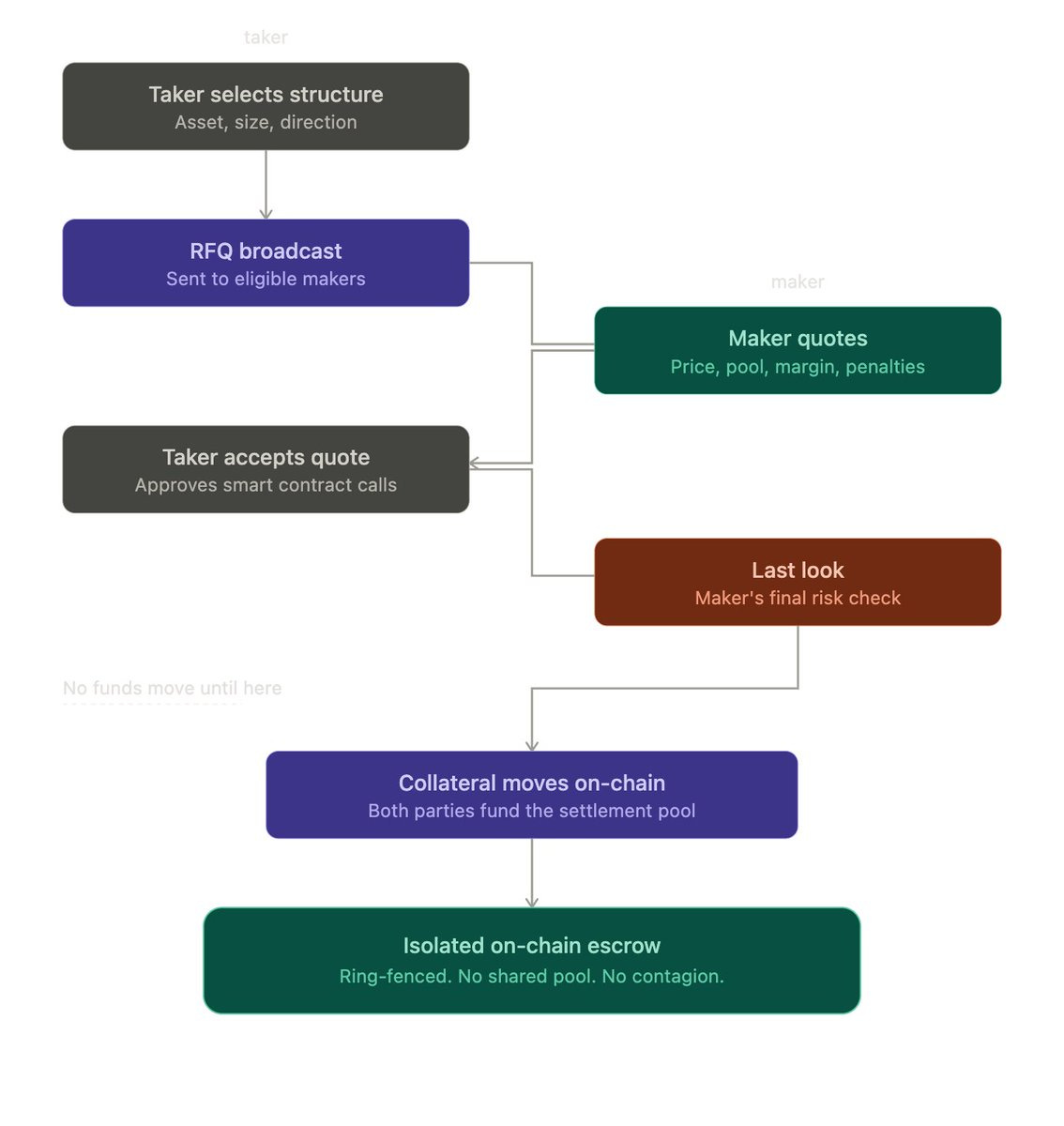
The taker initiates by selecting the derivative structure they want to trade. That RFQ is broadcast to eligible makers, who respond with a price quote, the settlement pool in which the trade will be booked, and all relevant parameters, including margin requirements and liquidation penalties. If the taker accepts, they approve the smart contract calls. No funds move yet. The maker exercises a “last look,” a final risk check. If approved, collateral from both parties moves into an isolated on-chain settlement pool, the trade is booked, and the position is live.
Each position is ring-fenced in its own on-chain escrow contract. No shared pool. No contagion between positions.
A critical structural difference from CLOB-based platforms: RFQ does not require a standing orderbook and does not need to attract and maintain its own native liquidity per market. Instead of waiting for buyers and sellers to post opposing orders, OLP taps directly into external liquidity sources, CEXs, DEXs, and OTC desks to price and hedge each trade as it is requested. The liquidity already exists across the market. RFQ aggregates it on demand rather than recreating it from scratch on-chain.
On Omni, the retail-facing product, this flow is simplified to its essentials. OLP acts as the sole eligible maker. The user fills out the order form, OLP responds with a single price quote and the user accepts or walks. All pool parameters are pre-set. OLP’s last look checks the trade against its risk limits before collateral moves are made. The entire process completes in seconds.
The listing scalability this enables is a direct consequence of the model. All OLP requires for a new listing is a reliable price feed, a quoting strategy, and a hedging mechanism, all built in-house, which manifests as approximately 500 tradable markets on Omni, with RWAs and other exotic markets to be added in the future. No orderbook depth to bootstrap per asset. No liquidity fragmentation. One vault, quoting across everything simultaneously.
Economic Incentives — The Points Play: Farming Variational Before the Crowd Arrives.
The biggest wealth transfers in DeFi did not come from trading. They came from being early to the right protocol. dYdX turned active traders into millionaires overnight. Hyperliquid did it again, and on a scale that made the rest of the sector look timid. Aevo followed. Every time, the formula was the same: use the protocol, accumulate points, receive a token allocation that rewarded the believers before the crowd arrived. Variational is running the same playbook. The points program is live, the $VAR token has 50% of total supply reserved for the community, and the window has not closed yet.
Points distributions kicked off in Dec 2025, retroactively allocating 3 million points to existing traders, with 150,000 points per week running through Q3 2026. Traders active before 17th Dec, 2025 received a permanent 10% boost on all future points earned, a compounding structural advantage across the full program duration.
The native
token is designed for governance and value capture through protocol buybacks and burns, with 50% of total supply allocated to the community. In a sector where most protocols reserve the overwhelming majority for insiders, VCs, and advisors, 50% community allocation is a meaningful commitment to rewarding the traders who built the volume base.
The Retail Buy Off: Empowering the Masses via Variational’s Cost Model
Every perp’s platform in the sector is built on the same extraction model: fees and spreads flow outward to external market makers who have no stake in the protocol’s long-term success. The house eats first. The trader gets what is left.
Variational is architectured differently. OLP is the internal market maker, which means no value leaks to third parties. The Variational team is incentivised by volume, not by maximising spread per transaction, so the protocol’s commercial interest and the trader’s commercial interest are aligned: make trading as cheap as possible, attract more volume, and let that volume drive protocol revenue and OLP yield. Cheap trading is not a cost to the protocol. It is the growth engine.
The 90% of the spread revenue that does not go to the protocol treasury is redistributed back through OLP yields and user reward mechanisms. What you pay stays inside the system and comes back to you. No extraction. No leakage. That is not a fee promotion with an expiry date. It is how the business model works.
Variational OLP: The Liquidity Engine
OLP is a vertically integrated market maker and breaks down into three components: the vault, the market-making engine, and the risk management system. The vault is the on-chain smart contract where capital is held and profits accumulate. The market-making engine runs proprietary algorithms analysing real-time data from CEXs and on-chain sources, including flow and volatility, to generate competitive price quotes across all markets. The risk management system runs proprietary algorithmic strategies to hedge directional exposure and optimise long-term yield.
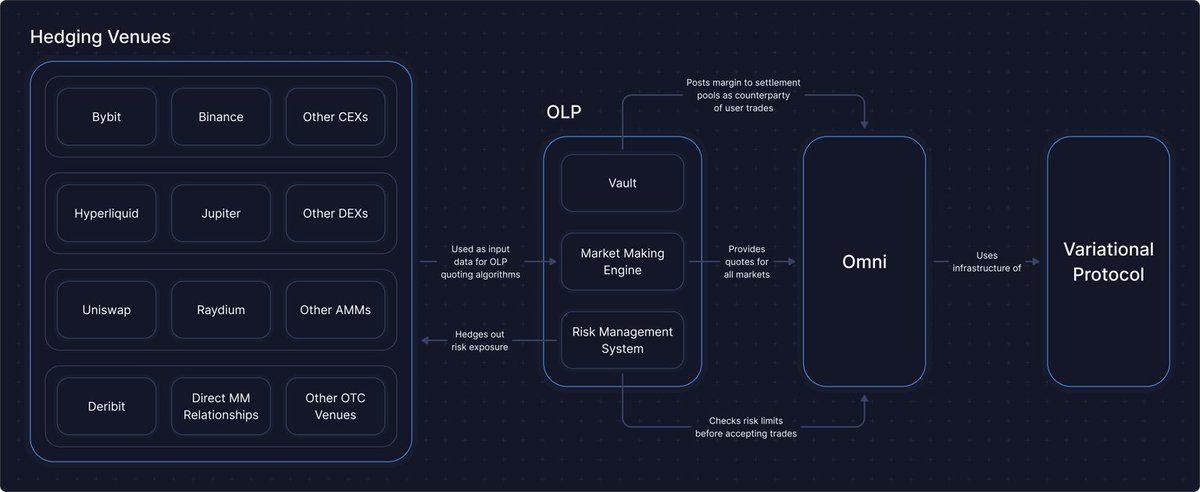
On fund safety, the architecture is explicit. OLP never transfers traders’ funds to external venues. Only OLP’s own capital moves externally for hedging purposes. Each user’s collateral is held onchain in a segregated settlement pool, used solely as margin for their own open positions. If an external venue suffered an incident, traders could still withdraw their remaining funds on Variational.
OLP is the first vault that simultaneously runs a sophisticated proprietary market-making strategy and acts as the sole counterparty to all user trades, which differentiates it from both HLP on Hyperliquid and JLP on Jupiter. HLP runs a market-making strategy but is not the sole counterparty. JLP is the sole counterparty but runs an AMM strategy rather than a proprietary one. OLP does both.
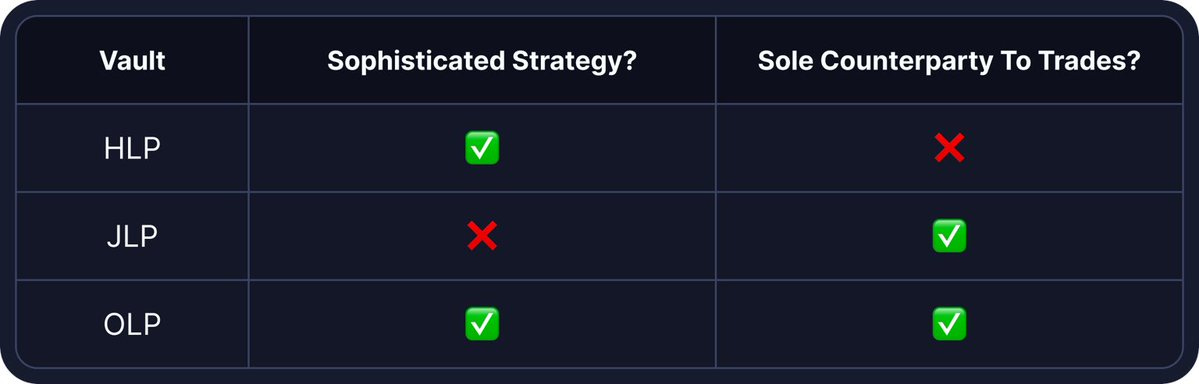
Once the system demonstrates a stable track record of generating market-neutral yield, the OLP vault will open to community deposits, allowing users to contribute USDC and participate directly in the market-making revenue.
Institutional Invasion: The Case for Variational Pro
Variational was not built for retail first. The institutional product, Variational Pro, was the original vision. The founding team came out of Genesis Trading, one of the earliest and largest institutional OTC market makers in crypto, and the problem they set out to solve was the one they lived inside for years: OTC derivatives trading is slow, opaque, bilateral in the worst sense, and entirely dependent on trust and legacy infrastructure.
Omni, the retail perps product, is the first application built on top of the Variational Protocol. It proved that the architecture works. Pro is what the architecture was always designed for.
Global OTC derivatives volume runs at an estimated $600 trillion annually. The structural reason it has never migrated on-chain is straightforward: institutional desks require instrument-level customisation, bilateral counterparty selection, isolated settlement per trade, and on-chain finality. None of the existing Perp architectures, orderbook or AMM, were built to satisfy those requirements simultaneously.
Pro is designed to extend the same RFQ infrastructure that powers Omni into that gap. Multiple market makers compete in real time for a single institutional request. Every contract parameter is customisable: underlying asset, settlement date, margin structure and expiry. Settlement and clearing are handled automatically by the same isolated pool architecture already running on Omni, replacing the current workflow of manual negotiation over encrypted channels and delayed legacy settlement.
The founders spent years inside the machine they are now rebuilding. The foundation is already in production. Pro is the institutional layer being constructed on top of it, and for Variational, it was always the point.
4. The Paradigm Shift: Variational Market Impact and Penetration.
Liquidity Wars: How P2P Beats Orderbooks in Depth and Efficiency.
The debate between P2P and Orderbooks is a never-ending one, but as Miyamoto Musashi said, in battle, if you make your opponent flinch, you have already won.
Legacy order books require resting liquidity, as market makers keep capital in visible bids/asks 24/7. This can create shallow depth on alts/long-tail (e.g., most DEX CLOBs cap at 100–300 markets with wide spreads), but it evaporates during volatility (HFTs cancel first) and forces subsidies or wash trading to fake metrics.
P2P beats Orderbooks via RFQ in the following ways:
Takers request a quote: sole OLP responds with a custom all-in price sourced from aggregated feeds (CEX + DEX + OTC + DeFi liquidity). No resting orders needed and this allows Omni to have the most listed markets of any onchain trading platform (450+ even before RWAs) without compromising on spreads or liquidity depth.
Since Orderbooks burn efficiency on multiple fronts: taker fees + spread capture by HFTs, funding rate bleed from imbalances, MEV/front-running on DEX versions, and external MM subsidies that inflate costs, P2P via (RFQ + OLP Architecture) solves this by Zero trading fees (only a tiny 0.1 USDC deposit fee). Variational takes 10% of OLP spreads; the remaining funds are for refunds/rebates.
From Dec 26–Jan 23 alone, Variational’s OMNI generated $4.4M in revenue, of which $3.2M went to the OLP, $824K to loss refunds (now sunsetted), and $394K to referrals. This makes Omni the only platform where market-making revenue is shared back with the traders who help generate it.

P2P dominates orderbook via Dynamic hedging & risk isolation as OLP aggregates real liquidity across venues and hedges externally with sophisticated (non-1:1) strategies. No directional risk buildup like orderbook books. Counterparty awareness (RFQ identifies users) lets OLP tune limits per-user/market, blocking toxic flow/manipulation in ways orderbooks can’t.
Variational highlights below how their OLP protects itself from market manipulation
P2P dominates adaptive pricing without periodic funding drama: RFQ quotes align to CEX oracles in real-time windows; isolated pools handle margin/liquidation per-trade. No global imbalance cascades or oracle-gaming vulnerabilities.
In summary, the P2P model thrives over other models because it eliminates custodial risk, cancel-priority/free last-look, opaque manipulation, MEV reordering, resting-order evaporation, wash-trading incentives, impermanent loss for LPs, size-dependent slippage, and oracle-dependent fragility.
Adoption Assault: User Growth, TVL, and Volume Metrics, Fees and Revenue.
According to DeFiLlama, the total cumulative Derivatives volume has reached approx $14T, with a combined TVL of $3.12B and an approx OI of $15B.
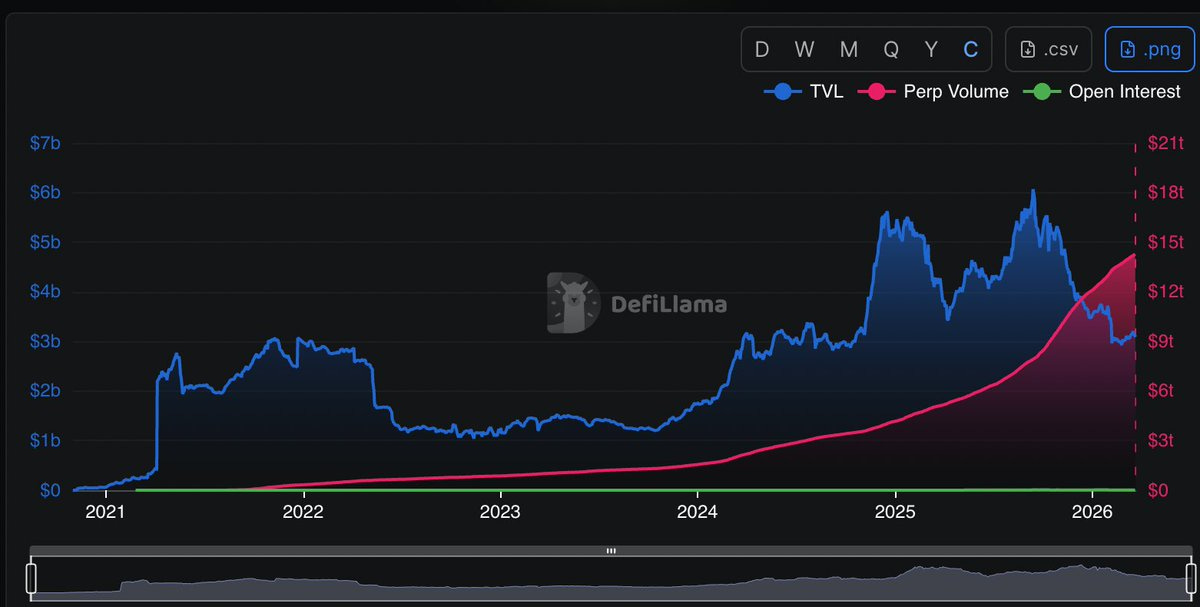
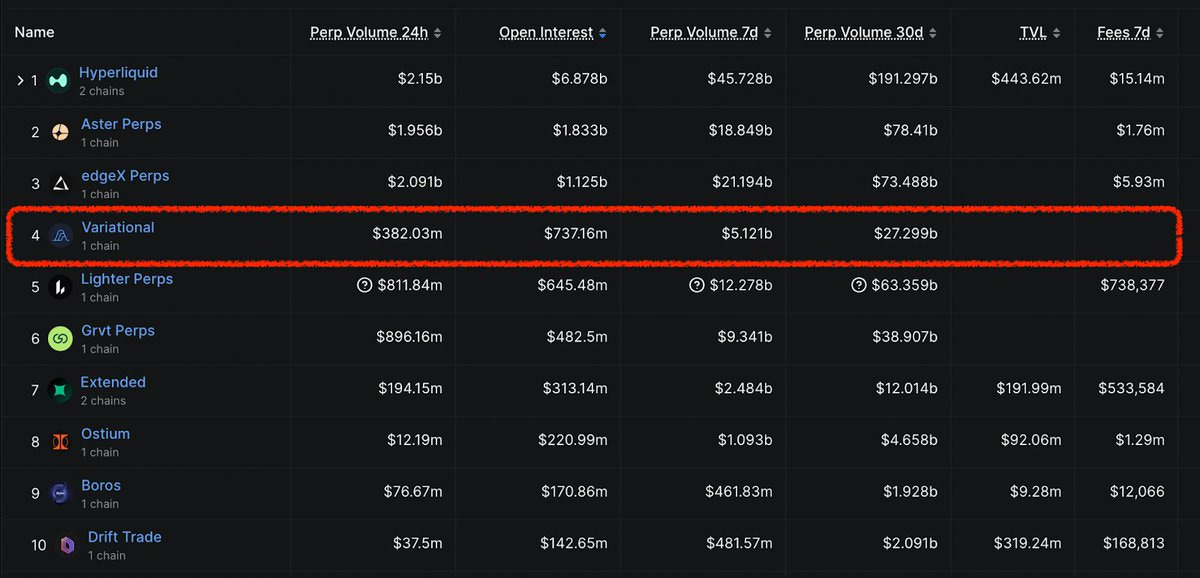
Variational is currently ranked 4th in OI, sitting just behind two giants, Hyperliquid and Aster, which is a crucial metric for measuring current open position (Long or Short) in a Perps platform, unlike volume, which has been closed.
With a current ranking of 4th in Open Interest (OI), Variational follows closely behind industry leaders Hyperliquid and Aster. This metric is vital because it represents the total value of active long and short positions, offering a more accurate reflection of sustained platform activity than trading volume, which only captures completed trades.
This high level of OI serves as a testament to traders’ confidence in Variational, as it encourages long-term position holding. This is driven by its low funding rates and the unique advantages that differentiate it from traditional Legacy Perp models.
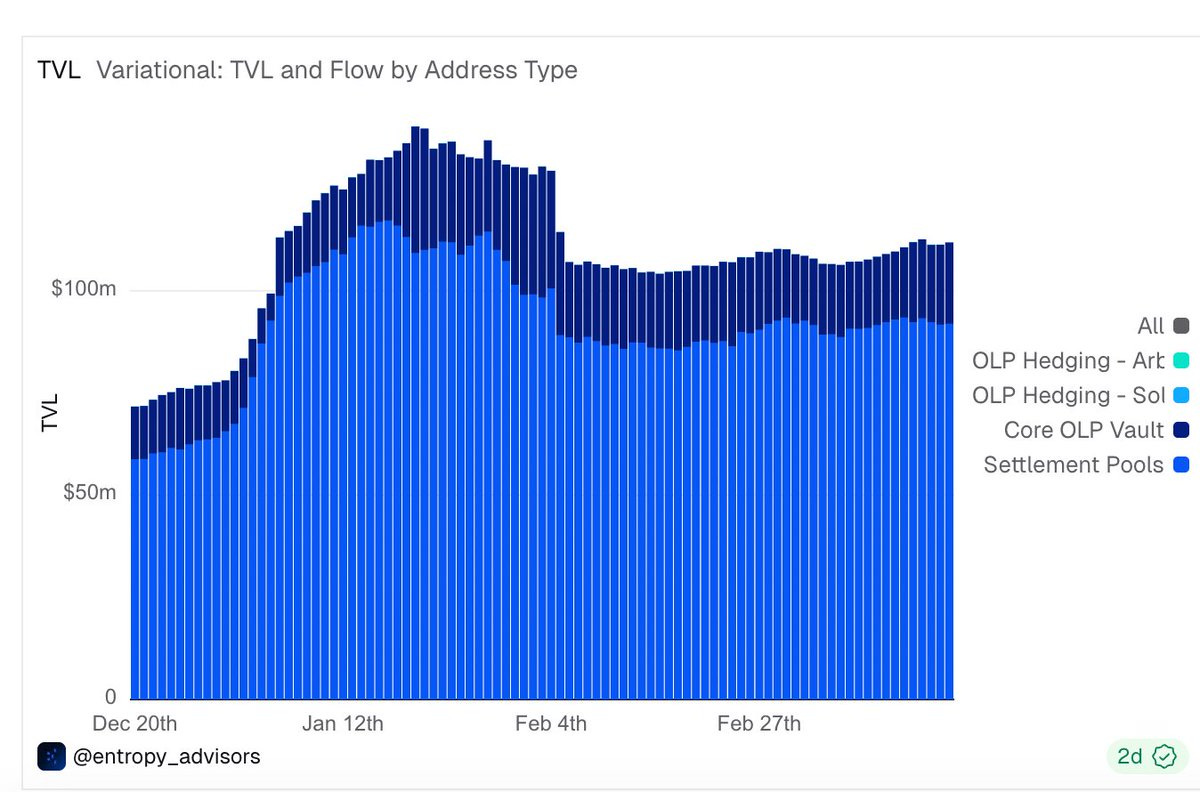
Variational TVL hasn’t been static but has been growing despite market sentiment. It has a combined TVL of $111.90M TVL, which all comes from OLP hedging on Arbitrum and Solana, the OLP vault and settlement pools.
This signifies Varitional’s growing liquidity and adoption of the RFQ model.
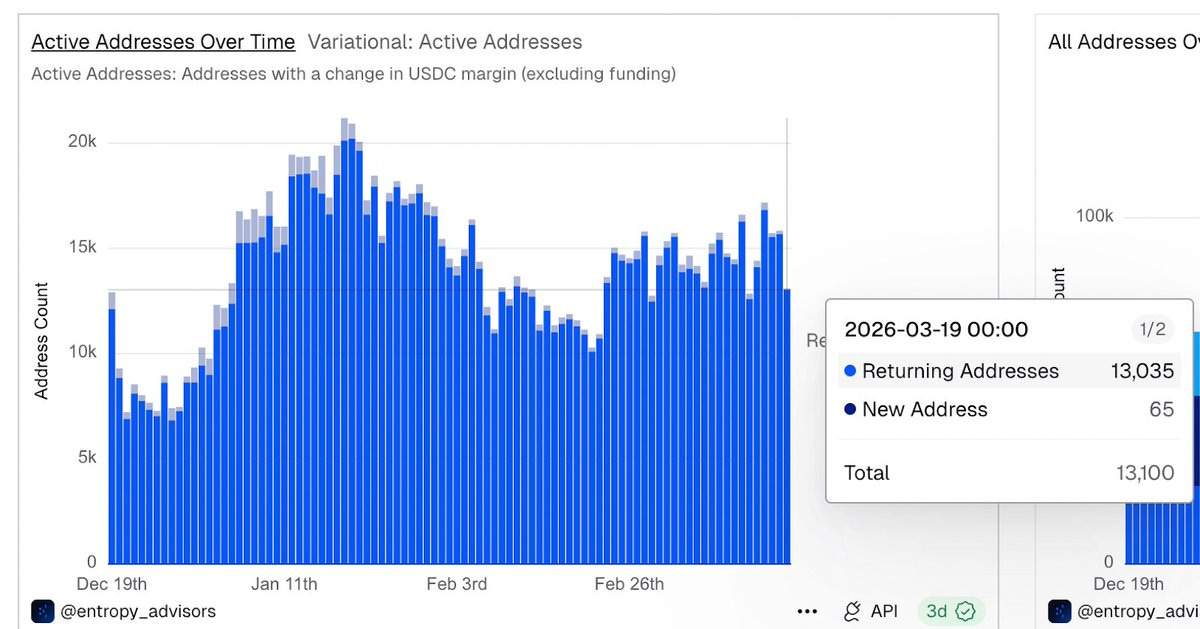
A total of 137,340 addresses have been created on Variational, with 87,107 activated and 32,382 currently live.
The active addresses since Dec 19th have been in an uptrend growth and to further complement that, Variational has had more returning addresses over time than new addresses being created.
This highlights traders’ stickiness with Variational as the best platform for trading.
Risk Rampage: Comparing Liquidations, Funding, and Volatility Handling.
You might have thought the war was over, but not yet, as Variational disarms the entire battlefield with isolated P2P escrows, RFQ-driven mechanics, and OLP’s sophisticated hedging and this is where it gets more interesting.
Comparing Liquidations
Legacy Perps system has relied on shared orderbooks/pools that turn volatility into liquidation cascades, funding bleed, and directional blowups, but Variational flips the script with per-trade bilateral isolation, dynamic quoting, and non-1:1 external hedging.
Full liquidations on most legacy perps are triggered when the mark price crosses the maintenance margin (often oracle-driven). Shared pools or order books mean that one big wick cascades into mass liquidations, as highlighted in liquidity illusion. For instance, CEXes like Binance use ADL (auto-deleveraging) in extreme cases.
Perp DEXes like GMX, Drift and Aster also suffer pool-wide insolvency risk during vol spikes. Hyperliquid and dYdX hybrids still expose shared book depth. Retail traders get fully liquidated on wicks and the system amplifies downturns (2022–2025 flash events proved it).
Below is a classic liquidity void case on dYdX.


In Variational, each position settles in its own smart contract pool with OLP as the sole counterparty. Liquidations are partial-only (no full wipeout) and carry a flat 0.5% penalty. Mark Price uses EMA smoothing to dampen oracle wicks (which are explicitly designed to protect against legacy flash-crash liquidations). If a position hits risk limits, OLP’s last-look rejects or adjusts before execution.
It’s a win for Variational here.
Comparing Funding
Variational’s edge lies in its adaptive, isolated, and CEX-aligned model, which eliminates negative-EV bleed while keeping prices anchored, unlike most Legacy Perps, where users are ravaged by it during trends.
The fixed funding Intervals (1–8-hour) in which longs pay shorts or vice versa, based on perp vs spot divergence. The drawback of most CEXes lies in internal skew manipulation, while some DEXes rely on oracles with delays, creating arbitrage and “funding bleed” resulting in 10%+ annualized in imbalanced markets.
It’s another round win for Variational here.
Volatility Handling
In Legacy Perps, Orderbooks (CEX CLOB or DEX hybrids) accumulate directional risk in the shared book. HFTs cancel during vol spikes, resulting in liquidity evaporation, MEV front-runs on DEX, and/or oracles lagging. GMX Drift and AMMs suffer impermanent loss and Hyperliquid’s high TPS still exposes resting orders to toxic flow. The whole cascade results in wicks, books thin out, and the liquidation of traders.
Variational handles this by leveraging its three-pillar OLP defence via:
Risk limits and counterparty awareness: OLP identifies every trader and blocks toxic flows/manipulation before accepting the quote.
Sophisticated non-1:1 external hedging - aggregates liquidity across CEX + DEX + OTC + DeFi, then hedges correlations/execution costs dynamically (no simple 1:1 matching).
Last-look and dynamic quoting - during vol spikes, quotes adjust instantly without resting orders evaporating. Isolated escrows contain any residual risk per trade.
5. Conclusion
There’s no end without a beginning. Variational has been one of the most Interesting Derivatives since 2024, after Hyperliquid’s emergence. It’s a full-blown war in the Perps landscape with different players all competing for the top spot and Variational is already taking the lead as we have all walked through this holy grail together.
We mapped the rise of the major perps platforms: Perpetual Protocol (Dec 2020), dYdX and GMX and Drift (2021), Gains and ApeX (2022), Hyperliquid and Aevo (2023), Aster and Lighter (2025). We dissected every liquidity model and exposed the persistent legacy flaws that plague both CEX and most DEXs: HFT/MEV taxes in shared order books, manipulation/bleed in periodic funding, fake depth with full-wick liquidations and cascades that amplify downturns (as proven in 2022–2025 flash events).
The breakthrough is the Variational Protocol’s P2P/RFQ and Omni Liquidity Provider model on Arbitrum. Its isolated bilateral escrows, on-demand quoting, sophisticated non-1:1 external hedging, counterparty-aware risk limits, adaptive CEX-aligned funding windows and partial liquidations directly scrap every legacy pain point.
P2P doesn’t just compete; it structurally resets the game, delivering deeper, more efficient, and trader-aligned liquidity than any orderbook ever could.
This research arc reveals @variational_io as the cleanest evolution in the Derivatives wars: transparent, risk-contained, and built to scrap the old playbook entirely.
References
https://www.investopedia.com/terms/h/high-frequency-trading.asp
https://www.apex.exchange/blog/detail/trading-perpetuals-on-a-dex-vs-cex
https://medium.com/poloniex/what-is-a-funding-rate-257e4cbeefe0
https://www.mettalex.ai/blog/perpetual-futures-trading-on-cex-vs-dex-a-comprehensive-guide
https://docs.variational.io/